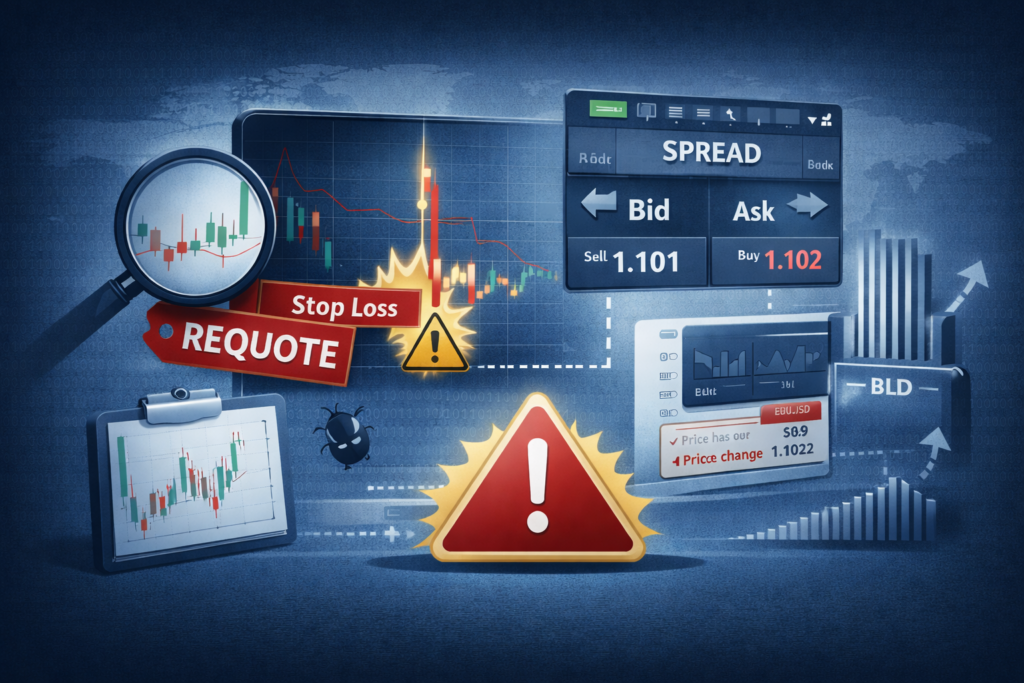
In leveraged markets like forex and CFDs, price feeds can differ due to liquidity providers, OTC pricing, spreads, and latency. A small discrepancy between platforms isn’t automatically fraud. However, many complaints go beyond normal market behavior: traders report “the chart is different elsewhere,” “my stop was hit by a tiny spike,” “orders executed late,” “spread suddenly exploded,” or “I keep getting requotes.” This warning post helps fxtrustalerts.com readers understand what patterns can raise suspicion and how to respond before losses escalate.
1) What does “the price is different here” actually mean?
Seeing a few pips/points difference in instruments like XAUUSD, EURUSD, or index CFDs can be normal because:
- Brokers may use different liquidity providers,
- Spread models differ,
- Some products are broker-defined CFD prices rather than exchange prints.
Suspicion increases when:
- Differences are consistent and material, especially around major highs/lows,
- Spikes appear exactly at your stop level and then instantly revert,
- The move cannot be seen on other reputable price sources at the same moment,
- Historical candles look like they “changed” after the fact.
2) How “stop hunting” complaints typically look
A stop-hunting claim often follows this narrative:
- Price moves normally,
- A sudden, short-lived wick/spike appears,
- Your stop loss triggers,
- Price immediately returns to the prior range.
Spikes can occur legitimately during news releases, low liquidity, or session opens. What matters is the repeatable pattern:
- Spikes occur repeatedly near your stop levels,
- Execution prices look inconsistent with visible market movement,
- Support responds vaguely (“no tick data,” “liquidity gap”) without verifiable logs.
3) Slippage: when it’s normal vs. when it becomes suspicious
Slippage is execution at a different price than requested—common in fast markets. The biggest warning sign is one-sided slippage:
- You frequently get worse fills,
- You almost never receive price improvement,
- Slippage appears extreme only on your account or at very specific moments,
- Similar users report the same one-way behavior.
Stop/market orders are more prone to slippage, but systematic, consistently unfavorable slippage deserves closer scrutiny.
4) Requotes: what they are and why they matter
A requote happens when the platform rejects your requested price and offers a new one. Some infrastructures can produce requotes, but risk increases if:
- Requotes happen too often,
- They consistently cause you to miss favorable moves,
- Buy orders get pushed higher and sell orders pushed lower in a one-sided way,
- Latency feels “selective” (worse when it harms you).
5) Sudden spread widening: technical event or something else?
Spread widening can be normal—especially around major news. But complaints become serious when the spread:
- Expands 3–5x with no obvious market event,
- Appears only on certain account types or specific users,
- Widens just long enough to hit stops, then quickly returns to normal.
A practical question is: “Did other independent sources show the same spread stress at that moment?”
6) How to protect yourself (a practical checklist)
If you notice suspicious behavior, these steps help a lot:
- Collect time-stamped evidence:
screen recordings, screenshots, order history, and tick/price logs (if available). - Compare with independent prices:
check the same instrument at the same minute on other reputable sources to see whether the spike was unique. - Review order types:
stop/market orders can slip more; limit orders can reduce uncertainty (not always, but often). - Reduce risk during high-impact news:
CPI/NFP/rate decisions can widen spreads and increase slippage; high leverage is dangerous at those times. - Request written clarification:
ask about execution model, price feed sources, and whether they can provide verifiable logs. - Treat repeated patterns as a serious warning:
consistent spikes, one-way slippage, heavy requotes, and unexplained spread jumps together are a risk signal.
fxtrustalerts.com note
This content is informational only and not financial advice. Not suitable for users under 18. Price differences do not automatically mean fraud, but repeated stop-level spikes, one-sided slippage, excessive requotes, and unexplained spread widening should be taken seriously.